
It is surprising that with the problem of “broken roads” so little attention is paid to clearance in the production of cars. In addition, when we travel outside the city into nature, we often witness how a flat highway turns into tattered country roads with holes and potholes. Even within the city itself there are areas where the road looks more like a roller coaster than a roadway. And even the joy of buying a new car can be overshadowed by its low landing, which becomes a problem already at the first curb near the house.
How do you know if you need to install spacers on your suspension?
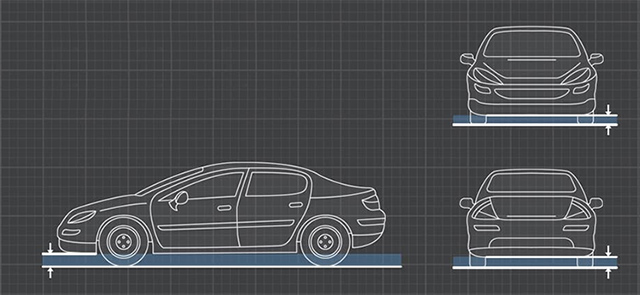
Other questions immediately arise:
- If so, how much should the car be raised so that it can pass easily even at high speeds;
- How important is this clearance in general? And how different heights of front and rear spacers affect the suspension.
We suggest moving along the path of least resistance and starting with determining the clearance:
Vehicle clearance is the distance from the supporting surface to the lowest point of the central part of the vehicle. The central part is a part of the car, enclosed between two planes, which are located parallel to the longitudinal plane of symmetry of the car and equally distant from the inner surface of the wheels.
Simply put, a car’s ground clearance is the distance from the ground to the lowest point of the car’s body. At the front it is the front bumper and at the back it is the rear bumper.
Most often, due to the low landing, the front part of the car suffers, which experiences all the irregularities of our roads: high curbs, snow piles, mountain roads, damaged surfaces, potholes, holes and bumps. We won’t even list all the deformations that any motorist encounters every day.
Let’s measure the ground clearance of our car.
To do this, use a tape measure or any ruler to measure the distance:
- From the ground to the bottom of the bumper. On average, the ride height for SUVs is from 20 to 30 cm, for crossovers – from about 18 to 25 cm, and for cars – from 14 to 20 cm. If your car has a “skirt”, do not rush to remove it, as it is the first barrier when your bumper comes into contact with the curb.
- From the ground to the engine oil pan or protective cover. In the case of a broken sump, there is a risk of oil loss, which can lead to engine seizure and subsequent major overhaul due to “oil starvation.”
A low ground clearance can lead to damage to the exhaust system parts located on the bottom of the vehicle. If your vehicle is rear-wheel drive, a low seating position can damage the vehicle by causing the rear axle or driveshaft to catch an obstacle.
And lastly, let’s discuss the basic rules for using and installing spacers:
- It is better not to install metal spacers that are not coated with an anti-corrosion polymer coating.
- If your car is front-wheel drive, it is better to raise the front of the car by no more than 20 mm (for passenger cars).
- In 80% of cases where the shocks are not mounted close to the springs, increased spacing is required for both the springs and the shocks to avoid tearing them apart.
- It is advisable to increase the ground clearance of the rear of the car so that the radius of the angle of inclination in high-speed turns does not exceed permissible standards (usually up to 30 mm).
Want to ask a question directly?
The managers of our online store will provide professional consultation and answer all your questions.